Tuesday, June 30, 2020

Pet Sematary (1983)


Ages ago, I mentioned in the Christine post, perhaps a shade too cryptically, that Stephen King wouldn't write another "proper" book until It, three years later. Well, what do you call this, then? For many Pet Sematary is the quintessential King novel, the most faithful to the horror genre since perhaps 'Salem's Lot. Ah, but to call the book "irregular" doesn't mean it's bad. It simply doesn't reflect the trajectory of King's early 1980's output and behaves more as a throwback.

Allow me to explain. Nowadays nobody is surprised that King can knock back three novels a year when he has stories to tell. However, as the Bachman books showed, even he was constrained by contracts and other artificial (paper?) barriers. Starting with Danse Macabre, King began to show he didn't need to hide behind a pseudonym any longer to release additional books beyond the "one per year" standard of most writers. I think part of it was due to the freedom of being released from his original publisher. Next thing you know, alongside the throughline of books like Firestarter, Cujo, and Christine came a new subset. The Bachman books were at this point still secret, but Danse Macabre, the first Dark Tower book, and the yet-to-be reviewed-here Cycle of the Werewolf ran alongside the "regular" books. However, his original publisher apparently wasn't through with him, as he left his contract a book short. He had written something so dark and horrid that he had indefinitely banished it to the darkest recesses of his desk, the unfilled final act of his first contract. So even though Christine was the Novel of the Year for 1983, Pet Sematary comes along for the ride, and likely ends up upstaging its predecessor.

It's quite a testament for this book to be so scary that even Stephen King wanted to keep it squashed, but there's nothing like the phrase "contractual obligation" to get something released against one's will. As King reminded us in Danse Macabre, horror is about the things that scare us. Typically the scarier the premise, the better the book at succeeding in the genre. 'Salem's Lot works because vampire are scary. Cujo works because rabid dogs are scary. The Stand works because global pandemics (as in the ones that kill 98% of humanity, not 0.5%) are scary. Of course vampires aren't real, rabid dog attacks are rare, and pandemics are a shared societal problem. What is really scary? Something that invariably happens to all of us: the loss of a loved one. Scarier even is the notion that their death was our fault. Fundamentally the death of a child, as a cruel reversal of the natural order, tears at all of us, even those without children of their own. It is one of the darkest places we can go, and Stephen King went there.

Pet Sematary
has two distinct parts: the before and the after. Part one is plenty sad. A family wants to make a new start, but the choice of house is challenging. It borders the back-of-beyond Maine, it's by a road that "uses up animals", and there's some pet sematary (sic) a short walk away. It's like they walked into the jaws of death. The father, Louis Creed enjoys perhaps the single worst first day any doctor has ever experienced, with a student dying on the operating table after a gruesome accident. That student takes Louis on a beyond the grave tour of a place beyond the pet sematary that must be avoided at all costs. His beer-loving neighbor Jud, not aware of this, lets Louis in on a little secret after the family cat dies, that death is not the end and the secret just happens to be the very place Louis's spirit-guide told him not to go. Aw, heck, it's just a cat though, so Louis goes there (in multiple senses) and revives Church the Cat. It's all sorts of wrong though. Church smells awful, has a mean disposition, and, when Jud's wife succumbs to her terminal illness, Jud does NOT take her there. Nevertheless, Louis manages to wrap up the book's first part with a perfect day of kite-flying with his son Gage and in spite of the deaths and questionable resurrections all seems to have turned out fine.

It turns out the kite-flying was just one last deep breath before Stephen King takes us down to plumb the watery depths of the book. It had been teased throughout the first part, but the unthinkable strikes when Gage is run down by a truck. Even though fully aware of how messed up Church turned out, and with Jud strongly discouraging him from taking another trip beyond the deadfall, Louis's heart overrides his brain and he works his long game to bring back Gage. He packs off his wife Rachel and daughter back to Chicago with the in-laws, spends about 100 pages fighting his way into the cemetery (the people one) and moving his son's corpse to the new burial ground to resurrect him. If you thought Church was a bad resurrection experience, Gage is something else altogether. Jud knew from past experience that people come back evil, but Louis, rent by grief, doesn't care about any of that. Reminiscent of that awful experience of Jud's, Gage returns as a full-on murder baby, killing Jud and his own mother, who rushed back from Chicago at just the wrong time. Even with all the bloodshed and destruction (Louis kills Gage and Church....again), Louis is spotted taking his Rachel toward the pet sematary, so we can relive the nightmare over and over.

Being Stephen King, there's a lot of supernatural stuff to unpack, as usual. The whole notion of resurrecting the dead is undoubtedly not something natural, there is some mystical Native American demon figure that seems to be pulling on the strings. This creature has its hooks in everyone's lives, taking the form of Rachel's bogey(wo)man, his sister Zelda. So it would seem that the secret burial ground isn't ginning up the inherent evil in Church, Gage, and all the rest (I mean, how much evil could Gage have took on at that age?!), but infecting them all with this omnipresent demon. Said demon may also be behind Louis's weird dream visions, as well as his daughter's inexplicable way of knowing something was wrong from over 1000 miles away....and inadvertently sending Rachel to her death. So, we can say perhaps there's a demon dwelling in all of hearts, preying on our weaknesses, exploiting the guilt, and that it isn't just us alone driving these grim decisions. On the flip side of the supernatural, this is one of King's most autobiographical novels, as the introductory essay explains, with many elements of the story being lifted from his own experiences (including the pet "sematary" iteself), revealing his own vulnerabilities about this own young family.

So while the next "proper" novel may be It, there is still much to explore before we get there. One more Bachman book, an oddball werewolf novella, a monster sized collaboration with Peter Straub, and the second great short story collection must all be addressed first. Pennywise will need to wait just a little bit longer.

Friday, May 29, 2020

Christine (1983)


No,  you aren't seeing double in the blog post titles. Christine set some kind of world record for page-to-screen time, with the movie released barely seven months after the publication of the novel. In fact, I've been so lame about posting here, almost more time has passed between the book and movie posts than the releases of the actual book and movie (I'll do the mature thing here and blame Covid). I wouldn't be surprised if the early production of this film predates the book's release, which would have made for an odd start and practically guarantee a movie that doesn't resemble the book. Thankfully it didn't go into Lawnmower Man territory though.

It seems like a natural fit for John Carpenter to direct a Stephen King adaption, but this is the only time this has ever happened. Then again, it doesn't seem like anyone (except maybe Mick Garris) has a fondness for directing these, and it isn't the first time a big name director took the helm, but follows the tortured tradition of Cronenberg and Kubrick's trips to the well. 

Like many movies from this period, the action was lifted from where the book takes place (in this case, Pennsylvania) to Southern California. So if your favorite part of the book was the vivid backdrop of winter, you aren't going to get this in the movie. For me, I was disappointed that the heroic sewage tanker Petunia was written out of this. Again, you can't squash a 500+ page novel into a 100 minute movie; something's got to give.

So, given this limited running time, Christine necessarily pivots to the more two-dimensional "demon car" narrative and the LeBay character is marginalized and merged into the character of his brother. Recall that in the book, the car is more a vehicle (no pun intended) for Roland LeBay to terrorize (1950's style) in the afterlife. In the movie, the car is born bad, killing a guy on the production line right in the opening. Plus, the movie is more clear that you can't kill Christine, which regenerates much quicker and it is made very obvious that crushing her (literally, not just emotionally) doesn't solve anything either, but just passes the buck to the next poor sap.

Finally, just like there are a lot of fun stories about how to make a dog act in a movie like Cujo, Christine has its share of mostly car-related trivia. I won't replicate that here. As for Keith Gordon and John Stockwell, both relatively new actors who played friends Arnie and Dennis, both later ditched acting and went into directing, although I have to say Keith made the smarter move directing good television, while John pivoted to crummy movies.

Monday, February 17, 2020

Christine (1983)


When all the trucks become self-aware (plus a rogue lawn sprinkler, or a toy), the result was unintentionally comical. However, when one car goes psycho, then it is truly terrifying. Frankly, I would be more scared by a bunch of trucks. Heck, even one truck in a Duel style encounter would be pretty unnerving. So all credit is due to Stephen King for creating a cherry red Plymouth Fury with a real mean streak.

I think this book, like Cujo, gets misrepresented when one tries to boil the plot down to a couple sentences. As you may recall, to the uninitiated, Cujo is thought of as the book where a rabid dog runs all over town randomly killing people. Similiarly, Christine is thought of as the book where a possessed car drives all over town killing people. Really, the car gets a bum rap in these summaries. The really nasty guy is the ghost of Roland LeBay, the thoroughly unlikable fellow who sells lifelong loser Arnie Cunningham the car. Perhaps it is not obvious to the people she is running over (repeatedly), but Christine isn't acting alone. Of course making this into a simple "possessed car" tale is an easy crutch, as the movie, which came out in record time after the book, will show.

Let's talk about location. Christine is one of the least Maine-oriented books King had written. In fact, I don't think the state gets a single mention. This isn't his first foray out of the Pine Tree State, as anyone who has read The Shining of Firestarter can attest, but it is still the default location of a standard Stephen King horror novel. Instead Pennsylvania gets the starring role. I'm not sure what reason he had for moving it out of Maine except for diversity's sake, but location does not play a critical role in the plot. In some ways that's good for building the "it could happen anywhere" sense of dread in his readers.

The most interesting structural device of the novel is the shifting point of view. Our narrator, Dennis, Arnie's unlikely best friend, suffers a serious accident at the end of part one, one so bad he is "fired" from his role in the second part. If he hadn't been, readers would have been treated to a heart-pounding tale of being confined to a hospital bed for months. Arnie doesn't supplant him in the role, but he is the focus in the middle section, enjoying a Dorian Gray type of transformation from ur-dork to a 50's rocker. By the time Dennis gets his narrator job back in the third part, Arnie is too far gone. Dennis is probably relieved that he just had to "kill" the car and not his friend. It's a coming of age story with a twisted, ugly ending.

Final thoughts: Christine is one of the better Stephen King books. He tottered a bit in his post-Dead Zone novels, the first Dark Tower felt stitched together, and the 1980's Bachman books were mostly dreck. Different Seasons was a real shot in the arm that reversed the doldrums, but Christine showed that this mini-renaissance of the early 1980's wasn't due to avoiding the horror genre. Christine is every bit a horror novel, driven by supernatural forces of fate and featuring The Thing That Cannot Be Killed (thanks Danse Macabre!). Not much here can be explained by purely rational explanations, as we saw in Cujo and most of Different Seasons. However, Christine will be the last "normal" book for quite some time in this project. As we move into the next titles, I will try to explain why we aren't going to see a book not published under unusual circumstances, until we reach It, whenever that might be.

Monday, January 20, 2020

Stand By Me (1986)

Housekeeping note: It wasn't my intention to take four months off from the blog, but I have continued at least the reading part of this project. With a new job, a new year, and hopefully a fresh new perspective on things in general, I plan to get this blog back up and running. Thankfully I'm just a handful of books and movies behind. The posts may be a little shorter for a little bit as my memories are a little less fresh and because I really want to get caught up again. All right, that's it. Now where was I?


Of the three Different Seasons movies, the irresistible power of nostalgia and the relative lack of gory content propelled "The Body" to the silver screen first, under its new name, Stand By Me. This should have been an obvious clue that the movie was going to deviate from the source material. For some reason I had it in my head that this was the "faithful" adaptation and that Shawshank was the rebel. It turns out that is quite the opposite.

First off, this movie is about 90 minutes long, while "The Body" is the longest of the four stories, so something is going to end up on the cutting room floor. For a lot of reasons this is a good thing. Nobody needed an adaptation of Gordie's "other" story (the one that was not about Lardass), that may have been the most depressing thing Stephen King even wrote. Speaking of depressing, I was fine with not learning the fates of Vern and Teddy in their adult lives. On the other hand, some character development was lost. Ace in particular went pretty flat. He was far more menacing in the story, and believe me, he was not going to let the incident at the tracks just slip past him.

Secondly, director Rob Reiner decided to double down on the nostalgia. The soundtrack really carries the movie, so much so you need to remind yourself the Walkman hadn't been invented yet and that portable radio just knew the right song to play at the right time. Another change for the sake of nostalgia is bumping the year back from 1960 to 1959. That way it makes it a 50's movie rather than a 60's movie, more Happy Days and less Wonder Years. Other changes I cannot explain. Why Castle Rock was moved from Maine to Oregon is past me, for example.

Naturally the casting was a huge stroke of brilliance, though that observation is rooted in pure hindsight. Some of them (Corey Feldman, Keifer Sutherland) were known quantities going in, while Wil Wheaton and River Phoenix had their breakthrough roles in this film. Jerry O'Connell was the late bloomer, and for playing such a hapless character, probably turned out the best of the bunch (unless you identify as high nerd, in which case that goes to Wil Wheaton). If you have some time, check out their Wikipedia headshots and not one of them looks much of anything like they did in the movie. People change, but wow.

On a personal note, this is not only one of the first (if not the first) Stephen King movie I ever saw. It also is one of the first (if not the first) R rated movie my parents let me watch.

Friday, September 6, 2019

The Shawshank Redemption (1994)

Critically-acclaimed movies based on Stephen King tend to be few and far between. Yet the valiant attempts to adapt never seem to subside, and now it is spreading into television, which has largely replaced movies without tons of explosions.

I first saw this movie back in 1994 in the theater. I was visiting a friend in New York and had no idea it had any connection to Stephen King. At the time I definitely didn't think it would become the award-winning basic cable staple that it turned in to. Now I think I should have had shirts made bragging that I saw it "first". Oddly enough I never saw it in its entirety again until this summer, so when it came up in this project, I was actually pretty excited.

Clearly a good deal of time passed between my first viewing of the film and reading the story. Therefore, I felt that the movie messed around with the source material to make the story more cinema-ready. However, on the second viewing I think I'll take that back. I think Shawshank culture (see below) made me forget that much of the grit from the original stayed in the movie. There are a few understandable consolidations of various events, but nothing sending the plot in a different direction. Red and Andy still reunite at that hard-to-say place on the Mexican coast. Ahhh....

Speaking of which, Shawshank culture is amazing. Some genius managed to manipulate it into a rom-com trailer:


And although released in the middle of the 16-bit era, here is the 8-bit video game version:


God bless the Internet!

Wednesday, August 21, 2019

Apt Pupil (1998)


Different Seasons spawned three movies (an impressive 75% conversion!) and two of them were good. This was not one of them. It wasn't bad, but just okay. The source material definitely sets a high bar, so expectations may be to blame.

"Apt Pupil" is technically the subtitle of the story "Summer of Corruption" and true to form there are no winners in the story. Both Todd, the punk kid turned Nazi sympathist, and Dussander, the Nazi turned scared old man, begin their respective journeys toward their inevitable suicides. Clearly the producers, in spite of Brad Renfro's involvement, were not going to go this dark. Instead, they decided to make Todd more resilient. Since Dussander was a Nazi, he still dies; nobody is going to miss him. Todd, on the other hand, has grit. He fights back against French. So instead of deciding to go out in a blaze of glory after being exposed, he concocts some dirt on his old counselor to ensure he lives to see another day.

I'm still trying to puzzle out where the movie fell flat. The story is a good deal more gruesome that the movie. Todd and Dussander kill a lot more "winos" than the movie depicts. Also, the intricacy of the writing just doesn't lend itself to a plot that would fit neatly into a normal movie running time. Yet at the same time to really feel just how far these two fall you need to read about all the nightmares and evil deeds, not just some representative acts or consolidations for the convenience of making it under the two hour mark.

Anyway, watching Apt Pupil isn't the worst mistake you'll ever make, but bear in mind that the original story is way better, though not for the faint-hearted.


Monday, August 12, 2019

Different Seasons (1982)


It was truly a joy to read my first 5-star Stephen King book since The Long Walk. For the most part the books typically are 4-star territory while the movies average around 3. Longtime followers of this blog will know we've gone through some real dogs, such as the other Bachman books, or books that cater to way more die-hard King junkies than I think I'll ever be (Dark Tower). Of course, there are some unexpected gems along the way, like Cujo. Given my unexpected enjoyment of that book, I suppose it isn't a huge shock that I'd go for this book pretty strongly.

I think we are hitting the first nexus in the Stephen King writing career story. Given his early success with just about every 1970's novel he wrote under his own name, any publisher would be perfectly content to pigeonhole him into horror fiction. He writes about people with supernatural powers that cause them pain and trouble (Carrie, Firestarter, The Shining, The Dead Zone) and monsters in our midst ('Salem's Lot, The Stand). All of these depend on the reader accepting that there are things more powerful than our boring old physics will actually allow. In the case of the former, these folks will ultimately triumph over adversity, while in the later they will largely be suppressed by "regular" people, but not destroyed.

In Danse Macabre, King stepped away from the veil of fiction to reveal a writer not comfortable with simply producing stories that run one way or the other. Nor did he feel that writing "literary fiction" meant something boring. We got an inkling of what else he could do in the mixed-bag Night Shift story collection, but Cujo was probably the first effort under his own name where he left the supernatural behind. Although you could run with the monster-in-the-closet concept and graft the idea of supernatural possession on to a dog, that is a stretch. He was ultimately a rabid dog thrust into a web of poor decisions by fallible humans. Nothing supernatural here, the cereal professor might say.

Therefore, Different Seasons is a continuation of King stretching out beyond horror, but not stepping into the dull. Unlike the last collection of stories, these are all original and "novella" (he mocks the term) length. Aside from the last story, it is all regular people, albeit in unusual situations. Shawshank is just your basic prison, featuring a guy who didn't do the crime he's serving the time for. A kid obsessed with Nazis decides to have a little harmless fun teasing an old man trying to hide his past indiscretions and both end up going more than a little deviant. Four boys in Maine want to see a dead body, a story captured in the reminiscing of a "serious" fiction writer. Finally there's a place in New York City where one can escape to hear a good story, even if the story is a bit strange.

As you can see, these can all be played straight, just from reading the single-sentence summaries. King takes them all in directions only he can do, so none of these turn into boring works of serious literary merit for serious literary journals. They aren't hack jobs though, which is the whole point King is trying to make here. There are no crutches to be found. The boys don't accidentally cross into Jerusalem's Lot and meet up with vampires. The warden isn't into black magic. Even when the final story, "The Breathing Method", breaks the boundaries into horror territory, one can easily say it's just a story within a story and no more real than the last campfire story you heard as a kid.

Having not read ahead, but being aware of what's to come, it is clear that King wasn't ready to leave the supernatural behind altogether. We'll take a break and prepare ourselves for the return of the possessed vehicle in the next book.

Tuesday, June 18, 2019

In Progress: Different Seasons

I know I appeared to dismiss progress reports in my last post, but I figured each of the four original novellas that make up Different Seasons deserve just a few thoughts.

"Rita Hayworth and Shawshank Redemption": First off there is no "the" in this title. You have simply watched the movie too many times. I'm looking forward to seeing the movie again, as the last time I saw the whole thing was in the theater when it was a brand new release. I feel like the tone is the same, but some events may have been moved around to make the narrative flow better. Most of this story is a ninety page manuscript smuggled out of prison up the narrator Red's posterior. I have no idea how that is possible, but I'm pretty sure it smelled wonderful.

"Apt Pupil": This is the longest story of the four and since I've heard the movie was mediocre, I was afraid this was going to be a slog. Thankfully, I was pleasantly surprised. No, there is nothing "pleasant" about this story. It involves Nazis and is telling we the readers that even 30 years after World War II, it is a poisonous ideology. What starts as a little harmless blackmail by a hyper-privileged 13 year old causes an old man fleeing his past to revert back into it, dragging the kid down with him. There are no heroes here. I went back and forth over who of the two was the worse. In the end the corruption gets everywhere, like radioactivity. Sharp readers will notice a brief connection to "Shawshank" that has no real impact on the story. I'm wondering if the others have any linkage.

"The Body": After a brief jaunt out to Los Angeles, we come back to Maine. The only connection I found between this story and the others is a few references to the Shawshank prison. In fact, this story has a stronger connection with Cujo of all things, thanks to being a proper Castle Rock story. Probably the biggest takeaway from the story is how closely the movie followed it. Some things are a little more fleshed out and a few other things are moved around, but it's really close. The bittersweet nostalgia fills every page and it really makes the readers think fondly of that time, even if they weren't alive, or nowhere near the area. However this is Stephen King, so it has its own fair share of creative cursing, purple prose, and gore. Like its fellow collection stories though it is not horror.

"The Breathing Method": Now we leave Maine once more, this time for New York City. This is really two stories in one. Maybe King was still trying to get some of the Dark Tower story structures out of his system. The "outer" story is the more clever of the two, about a man finding a home away from home with a lot of strange stuff in it, and mysteries abound. It is not a horror story. However, this strange place is built around storytelling, so the "inner" story that makes up the bulk of the tale is straight up horror. In fact, King acknowledges this is the great exception to the non-horror tone of the collection. I can see why this one didn't get the movie treatment. It's not that it is a bad story, but it would be hard to convincingly adapt.

Monday, April 29, 2019

The Dark Tower I: The Gunslinger (1982)

My big plan to do "in progress" posts for each book is kind of running out of gas. For anyone who cares, here is what I was thinking about 50 or so pages into this book:

"I really have no idea what any of this is about, so you'll be getting "straight from the gut" reactions here. So far, the book is a Russian nested doll and if I'm tracking things correctly, I've just read a story within a story within a dream. Is this Inception? Does time flow backward? Is the whole book going to be like this?"

So we are just going to move ahead to the finished book post and you can carry that confused snapshot with you throughout the rest of this.

It only took me until now to finally read a Dark Tower book! Stephen King frequently states that he regards this series as one giant book. The rest of the volumes are way bigger than this one, so there is much work to be done. Some of the reviews I've read about this, the opening "chapter" of the megabook, is that we should not judge it too harshly. It is different than everything that comes after it. For one thing, it is actually five short stories, with at least the first one long enough to qualify as a novella. These stories were all previously published in somewhat altered forms in the Magazine of Fantasy & Science Fiction in the late 1970's and early 1980's. I can only imagine what any reader that missed the previous installments was thinking reading these stories back then. Also, from what I can tell, King himself cleaned up the original version of this book to make things a little more consistent. It wasn't done to Stand-like proportions, so I'm not too worried about what changed. However, I was a little surprised to find out that the five stories do not differ substantially from how they appeared in F&SF, meaning the we aren't flashing back into the story proper; the original story treats it as a flashback as well. There is essentially no added connective tissue for the sake of making the book flow. This is to say the book does flow in spite of five different publications. Better for the book readers like me than the magazine readers, I suppose.

Going into this, I knew pretty much zilch about the Dark Tower. Although, thanks to hearing a few things on a podcast and seeing a movie trailer well before approaching this book, I sort of knew what was going on here. For the uninitiated, this book literally drops the reader in the middle of nowhere. I'm not misusing the word "literally". It is the middle and it is nowhere. As I wrote it my halfhearted progress report, the first story, the novella "The Gunslinger" is something like three flashbacks nested in one another. Although it shows a writer like King flashing some mad skillz, it is quite confusing. On the other hand, it does get us out of the middle of nowhere, as I don't think anybody needed or wanted 90 pages of chases in a total desert.

Two other stories, "The Way Station" and "The Slow Mutants", also turn on flashbacks. The non-flashback content, as the titles appear to indicate, is a bit ho-hum. The flashbacks, about Jake's previous life in New York City and Roland's in a fantasy novel respectively, are the meat of the story. If you don't care for flashbacks, "The Oracle and the Mountains" and "The Gunslinger and the Dark Man" stick to the present and reward readers who wondered what the big deal was with a magic jawbone. The present day stuff is a good deal more confusing than the flashbacks. For one thing, NYC is familiar territory for most, even if you've never been there. Roland's story is pretty much boilerplate fantasy. The scenes in the present make the reader wonder what the hell this "middle world" is. Did it used to be normal and turned weird? How does anyone get here. The point where Jake is sacrificed while they are traveling inside a mountain in the penultimate story nearly broke my brain. Was this some kind of subway station and our present is their distant past? How does a bridge get inside a tunnel? Are they in Wario's gold mine?!

Hopefully I'm not the only reader who walked away from all of this with more questions that answers, but I'm giving the book a wide berth. It needed a lot of tweaking (but not a full overhaul) from its original published form. It also never intends to stop at a satisfying point, as the next six books appear to indicate. Since it's one big book, the story will simply carry forward in the opening pages of The Drawing of the Three, published five years later. Therefore, I will not think of a witty closing line to this post, but rather just continue where I've left off here.

Friday, April 5, 2019

The Running Man (1987)


Although I've experienced some pretty awful movies done in the name of Stephen King, I think this is the first full-blown "action" movie of the project. If your movie features a pre-Twins Arnold Schwarzenegger, then I guess it is kind of a requirement. And of course, with an action movie, you get lots of corny one-liners, and this movie is full of them.

On the scale of 0 to Lawnmower Man of how much this movie deviates from the book, I'd give this an 8 or 9. It feels like an adaptation done by somebody who read the tease on the back cover and ran with it. Where the book is more like "The Fugitive", the movie fashions itself as "Smash TV", the hit arcade game of 1990, crossed with "American Gladiators". In fact, this movie was a big influence on that game. Where the book focuses on the grim dystopia of the outside world, the movie struts the glamour of the studio, barely acknowledging the crummy world it exists in. On the other hand, while reading the book was a bit of chore, the movie, while not good, was fun in its own ridiculous way.

The Ahnold version of Ben Richards is not a regular guy. In fact he's a straight up hero and police officer with a good heart that the system decides to crush. He does not enter the game willingly, but rather gets put in after his ultimately-unsuccessful prison break. Just to make sure nobody thinks he's a hero, they show the audience doctored surveillance footage of him massacring (not saving) hundreds of innocent people in Bakersfield (???) that looks suspiciously like the first scene of the movie. I guess they have super sophisticated cameras. The game itself isn't a real-world hide-n-seek game, but a real-life video game where the contestants fight "boss"-grade characters to their deaths. Judging from the rather horrified reaction of these bosses getting killed, it seems like they usually win. In fact, any incident of a contestant winning is quickly proven to be patently fake. Of course against all these odds, Ben Richards does not die, not by his own hand or those of others. Instead he bests the hopped-up American Gladiators (including Jesse Ventura, as a reluctant fan-favorite), beating not only the game but launching a revolution over everything wrong in the world. It's a feel-good finish, but not exactly original.

I can't leave this without a couple casting notes. First off, there is no way you can watch classic Family Feud after seeing Richard Dawson in this, and I mean it as a compliment. The guy best known for kissing female contestants in ways that would invalidate any potential run for the Democratic presidential nomination is dropping F-bombs and stage managing on-air death like a stone cold gangster. For all the failings of the movie, Dawson's casting was a stroke of brilliance. On a smaller note, Mick Fleetwood plays a guy named Mick who seems pretty bummed that bands like Fleetwood Mac aren't around in this parallel hell-world. I'd say he's probably pretty happy with our boring wold of tepid reality television, or at least consoling himself with the take from the latest world tour.

Wednesday, March 13, 2019

The Running Man (1982)


Ages ago, I read The Long Walk, my first Stephen King novel. This was so long after the outing of Richard Bachman that my copy didn't even bother to advertise it that way except in the fine print underneath King's name. I remember thinking that maybe I was more drawn toward the gritty Bachman style than King's more typical supernatural horror system. Now having read the other three books in the opening Bachman quartet, I think it is safe to say that probably isn't the case. Unfortunately, as was the case with Roadwork and Rage, The Running Man just isn't that good a book.

The Running Man is Bachman's return to the vague dystopia with an appetite for extreme entertainment last seen in The Long Walk. This time around, things are much less subtle. Things are totally dysfunctional and the air is literally not safe to breathe. Whereas the other novel hinted and nudged at what was wrong with the world, this one liked to shove hard. Things are pretty crappy in 2025 and it is thrown in readers' faces at every turn. The TV (er..."free-vee") tells us what do say, do, and believe. Well, actually I guess that isn't too far removed from today. That and the continued popularity of "reality" shows, though even the most gratuitous in our timeline don't touch the visceral entertainment of The Running Man.

I like to joke that every contestant on "American Ninja Warrior" is fighting against unimaginable odds in life, and that just their mere appearance on the show neutralizes all that pain. Nobody just accidentally ends up on the show, and certainly nobody gets on the show that has benefited from immense privilege or luck. So is the case with Ben Richards, who turns to the games as a way to pay his way out of a terrible situation of a sick child and no way out of the gray slums. Of course they don't just take anybody, so he pushes his way through a boot-camp winnowing process that earns him a spot on the most popular (and deadly) of the shows, "The Running Man". This show doesn't need fancy sets, and almost the entire populace gets to play along. Ben just needs to survive endless pursuit by the Hunters and the general population of informers, who earn rewards for their tips. Ben can't just hole up in a panic room for 30 days to earn his billion dollar grand prize. He needs to record himself and advertise his whereabouts twice a day. Furthermore, the producers of the game like to get the bloodlust flowing by heavily editing his footage to make him come off as a raging maniac. The good news (for Ben) is that there is so much disgust with the way the world works that he finds a few allies along the way, some more willing than others to render assistance. He also manages to uncover a vast conspiracy about air pollution that he does his damnedest to advertise through the show. Eventually he goes head to head with the Hunter-in-Chief himself, Evan McCone, culminating in a spectacular plane crash right into the heart of the Network's game headquarters, killing everyone (I warned you there all spoilers here, so sorry/not sorry).

In the right hands, there might have been some compelling story here, but the tone of the novel rings crass for the most part. First and most glaring is the technology. A lot of pre-1990's science fiction suffers from this and the stuff between (let's just say) 1960 and 1990 haven't aged enough to become cutely anachronistic. Therefore it is pretty laughable that Ben needs to wear a bulky body-cam with physical tapes that must to transmitted through the postal service. Now, it may sound like I'm making fun of Bachman/King for not anticipating the Internet, but I think it suffers more from being a rather contrived way of forcing Ben to not just play an advanced game of hide-and-seek with the Hunters. On the other hand, I can't really say what I would do, so I'll try to be generous. Second liability of the book is the characters. Bachman characters are not renowned for being King's most fleshed-out characters, but the cast here was pretty cardboard, especially the women and minorities. It is most ridiculous when we get to the climax and the supposed Uber-Hunter McCone turns out to be the world's stupidest negotiator, who refuses to call Ben's bluff but then claims he knew all along it was a bluff. Finally, the overall tone of the book is pretty choppy. Ben kind of comes off as a jerk, blowing up a building in a total-overkill moment, then pretty much ruining everyone he came into contact with. By the end, Ben doesn't even have anything to live for, learning that his wife and daughter, the very reason he was putting up with all this crap, were dead. I will tip my hat to Bachman though, that Amelia getting sucked out of the plane, though also very crass, was the most I think I've laughed at anything written by King.

As we will see in the next post, this was the only Bachman book to date that earned the movie treatment. The basic premise of the novel, merging dystopia, game shows, and the future was probably utterly irresistible. The novel in itself is a little thin on glitz, however, to make an exciting movie, plus the heavy amount of interaction between the game and the everyday world probably would send the wrong message, so the movie version is very different. Not Lawnmower Man different, but, as we shall see, different. Paging Arnold Schwarzenegger....

Tuesday, February 26, 2019

In Progress: The Running Man

In a note that was meant for Roadwork but never seen because it never had an "in progress" post, I mentioned I was reading the first four Bachman books in an omnibus edition with the exception of The Long Walk, the only one I already owned prior to getting this book. All Bachman books are available as individual volumes except for Rage, hence this book is here for the sake of being complete. What I'm getting at in the page numbers won't make any sense. This book is about 150 pages on its own, but starts on page 530 of the omnibus. However, it is conveniently broken down into 101 chapters, so I'll use that to mark progress.

February 25 ("75...and counting"): It looks like Bachman/King decided to revisit an unclear dystopia, a little reminiscent of The Long Walk. However, this one doesn't lack much subtlety thus far. At this point the game has just started so I have no idea where this is heading. Like any good Stephen King themed game show, I suppose death is inevitable?

February 27 ("63...and counting"): I guess it wouldn't be a very interesting book if Ben just decided to lock himself in a panic room. In fact, that's the reason they make him use his body camera to force him to reveal his location. Of course in this future there is no Internet so he sends the tapes via US Mail. But did he really have to blow up the poor YMCA just to get the Hunters off his case?!

Bachman may be trashy, but it sure reads fast! I polished off the book a couple days later. Spoiler alert: he dies.

Wednesday, January 30, 2019

Cujo (1983)


I inaugurated the year in movie-watching with Cujo a couple weeks ago. As with the book, the movie is not as bad as the reputation it carries of a psycho-dog killing random people. In fact, I was a little surprised by what seemingly-minor things were retained from the book, while other major plot points were cut. I honestly did not expect to see the Sharp Cereal Professor, but there he was foolishly pushing Red Raspberry Zingers. Meanwhile, Charity and Brett get out of town and you never see them again. Other changes I rolled with, given the running time of the movie was quite compact, such as Steve being some kind of family friend, already known to Vic. I also believe nobody was sad about omitting Steve leaving a....ahem...."gift" on the upstairs bed when he trashed the house.

Of course, there was one huge change from the book, which came from Stephen King himself. In the book, the big shocker is the death of Tad. On one hand, killing off children, even in the 1980's, was still a touchy area for movies. However, according to the vast amount of ink and pixels devoted to this change King apparently carried a heavy amount of regret for his decision to kill Tad in the book, so he "atoned" for it in the movie. Make no mistake, though, this movie is still really scary, probably the scariest one I've seen yet. I'm usually pretty good at separating real life from what's behind the screen, but the terror of being trapped in a car with a screaming child on the inside and a rabid dog on the outside is downright visceral.

Location, as you know, is always an area of scrutiny for me. I believe to date in this project, only one movie purported to take place somewhere in Maine was actually filmed in Maine. Alas, that was the wretched Graveyard Shift, proving location only isn't going to save a turkey. Cujo, as was the case with many of the early King movies, was filmed in California, in locations north of the Bay Area, with a bit of Utah thrown in for good measure. Needless to say, it doesn't look much like Maine, although if one disregards that, the redneck-chic of Joe Camber's garage/hovel is pretty much the way I envisioned it when reading the book. Again, this is one of the earlier Stephen King movies, the third one (after Carrie and The Shining) to be made into a feature film, just a few months ahead of The Dead Zone, in fact. To date this was one of the fastest page-to-screen jobs in King's bibliography.

Finally, an unusual little challenge for a movie like Cujo, even if it isn't all non-stop dog-killing-man action, is how to handle your animal actors. There are places that go into way more depth on this, so I won't repeat it all here, but let's just say that the actor-dog was quite the opposite of the role he portrayed. The silly dog ruined many a scene because he wanted to lick off the tasty "gore" put on him by the makeup department! I wonder if an outtake reel exists somewhere. It just might soothe any stray nightmares this movie left with you.

Tuesday, December 11, 2018

Cujo (1981)


Cujo is one of those Stephen King books that probably has an out-sized notoriety. The name has become virtually synonymous with rabid, or just plain mean, dogs. Most people will know that Cujo the book is about a dog gone bad, and they might even know that King wrote it, even though legend has it that King himself, in the throes of drugs and alcohol, has almost no recollection of writing it. So, I was a little surprised to discover that in many ranked lists, Cujo falls somewhere in the middle of the King oeuvre, well below the other novels written in his name prior to this. I was more surprised to read this book and see it not so much as a violent rabid dog story, but as a compendium of human failings.

As I mentioned in the previous post, Cujo is sold as a story about a dog holding an entire town hostage, killing on a mass scale under the sadistic influence of rabies. This really isn't the case though. Sure you get some high-octane gross-out dog mauling scenes, but the first two victims of Cujo are morally bankrupt and pretty much useless. It is only when you get to the last pages where the sheriff and Tad fall victim (the latter more indirectly) that you really feel like Cujo is a super-villain animal. The real tragedies before the final pages come in the separation and hopelessness felt by family members. Vic is away on a business trip, while Brett and Charity are on a short vacation away from Joe, a handy guy who is awful to his family. Their tragedies are having no idea what is happening to their family while they are away. Furthermore, they are actually in many ways glad to be away based on what they do know. Vic is dealing with the fallout of Donna's affair with the charming Steve Kemp, and Charity, a surprise lottery winner, is thinking of escaping her miserable home life with her newfound fortune...but can she convince Brett, who takes after his father? What is heartwrenching about all of this is that they have no idea what is happening back home until it's too late. Also heartwrenching is Cujo's fall into rabid insanity. King occasionally makes Cujo the POV character, so readers experience him first healthy and loyal, then sick and confused. It's as if another demon dog overtook Cujo's body. King never expressly makes this the case, but by intertwining the monster-in-the-closet subplot with Cujo's car siege, he leaves the door open to readers wanting some kind of supernatural connection between them, that a monster lives in Castle Rock, be it Frank Dodds, or Cujo.

Cujo is the first non-Bachman book to have no major supernatural plot element. No characters can read minds, cause things to blow up, communicate telepathically, change form, or teleport. This is more the hallmark of the three Bachman books released thus far. However, Cujo is a little more deft than the Bachman books in that it is more willing to crack into the psyche of its characters, in particular Tad and his convictions of the monster in the closet, so strongly held that the narrative actually supports it. Also, Cujo is directly linked to another King novel, The Dead Zone, which is firmly in the supernatural zone, albeit without the explosiveness of a Carrie or Firestarter. Therefore, I would suggest to those that are inclined to dismiss King's use of the supernatural as a crutch that keeps him stuck in "genre" fiction, to give Cujo a closer look. There is really nothing here that couldn't actually happen. Sure, the fears of monsters in the closet and the thoughts of a dog losing his mind are a bit speculative, but these aren't original to King, as any child or textbook entry on rabies will tell you.

Where Cujo does fall short is in the surprise department. I could see from a mile away how all the character paths would intersect and how Cujo would be involved enough the warrant the title of the novel. All of the elements leading up to the climatic Cujo v. Car showdown were pretty clear from the early part of the book. All told, though, the novel still holds up as a thriller that relies on natural, everyday terror to carry its plot.

Friday, November 23, 2018

In Progress: Cujo

The combination of some slow-reading non-Stephen King books and school responsibilities on top of full-time work meant an unscheduled October break from the blog, but at long last we've reached Cujo. Here are the usual running thoughts.

November 23 (Page 41): I knew going into this that this was one of the Castle Rock books, but Cujo forms a direct connection to The Dead Zone in the opening pages, referencing the middle section of that book. About 25 pages into the book, I also realized there are no chapters in this book, so all I'll say at this point is thank God for paragraph breaks.

November 26 (Page 124): The nice doggy is starting to turn, no surprise there. The description of poor Cujo losing his mind is totally heartbreaking though, like somebody where all the things that used to give them pleasure now only give pain. The real drive of the story right now is more centered on the other (human) characters, most of them awful, some of them powerless.

November 30 (Page 268): I knew going into this book that there was going to be a dog that kills people. My initial uninformed vision was one of a rabid dog indiscriminately taking out helpless townfolk, but the book hangs more on the suspense than gore. If anything is really gross about this book, it's jilted Steve Kemp the Homewrecker leaving a little "surprise" for Donna. As for Cujo, after killing off Gary and John (no tears there), he's been spending most of the time assaulting the Pinto, the only thing stopping him from eating Tad and Donna.

I pretty much finished the book too quickly for another update!

Wednesday, September 12, 2018

Danse Macabre (1981)


One of the joys of this Stephen King project is that I'm not just reading the "regular" novels. While the sequence of Carrie, 'Salem's Lot, The Shining, The Stand, The Dead Zone, and Firestarter is a fine illustration of King's early career, one cannot get a complete picture without the inclusion of the Bachman books and other less-than-standard fare. By 1981 that expands to include the first of just a few non-fiction works such as Danse Macabre, our featured book, and will go on to add collaborations, original novella collections, and something called "The Dark Tower" sequence. Loyal readers of the blog know we've had Bachman interruptions since almost the beginning, but now we're entering a phase where all these new projects get into the hopper as well. In 1981 alone two works got stuffed in between Firestarter and Cujo and 1982 has no "regular novel" as we will see in the months ahead here.

Danse Macabre touts itself as an overview of the horror genre, which makes it sound way more academic and tedious than it really is. In some ways it is more fair to think of it as On Writing written during the height of King's drug and alcohol binge days. With six novels under his belt (plus three more he wasn't admitting to just yet), he was a well-known author at this point, but with a reputation of being a writer of "pulp" and strictly confined to the horror genre. This book represents his opportunity to both embrace the genre and refute the critics. He does this fairly deftly and really the only thing that holds this book back is its age (more about that at the end). He tackles horror from all angles: the movies, the literature, television (pre-1981 television, mind you), and even radio. For the most part he confines discussion from 1950 to 1980, essentially from his earliest personal memories to the present day.

To get the ball rolling he steps back in time a bit. After a preliminary chapter about "the hook" which sets the parameters for what constitutes horror, he identifies three horror classics from well before the time period he is to discussion: Mary Shelley's Frankenstein, Bram Stoker's Dracula, and Robert Louis Stevenson's Dr. Jekyll and Mr. Hyde. Taken together they form the "tarot" by which all other horror spawns: the Thing Without a Name, the Vampire, and Apollonian/Dionysian Split Personality. Henry James is a bonus unofficial card as The Ghost, for his novel Turn of the Screw, but King routinely downplays the centrality of The Ghost to the others.

The movie discussion is divided into two chapters, which he admits from the outset is nowhere near enough ink to plumb the depths of the genre on film. I must say that he brings up a lot of truly awful movies in this section, with the second chapter even calling them out as "junk food" in its title. It seems like the main engine was the notorious AIP, the studio that handled the bulk of the Roger Corman oeuvre. That should give you an idea of what level we are working with. For the most part the first chapter says we shouldn't settle for only high-quality films, but then the second part cautions against a diet of pure junk food when it comes to movies.

The television and radio stuff was kind of a blur, as radio horror was pretty much DOA by 1960 and television even by the 1980's was nowhere near what we now come to expect in the heady era of "Peak TV". This takes us to a monster chapter on horror fiction, which is really where I make a point of listening more closely to what King has to say. Rather than attempt to cover a lot of material at a very shallow level, he uses some exemplary titles to illustrate horror fiction during this thirty year window. Some authors are no surpise: Shirley Jackson, future co-author Peter Straub, and Ira Levin. Others are a bit odd for being better known in other genres: Anne Rivers Siddon, Ray Bradbury, and Harlan Ellison. He also devotes some space to two authors I've never heard of: Ramsay Campbell and James Herbert, both British and very much entrenched in the genre. It is here though that King makes a tripartite distinction in fiction. You have literature, genre, and pulp. Exclusive readers of the first consider all the rest to be mere "genre" (using the term derisively), but King points out there is a middle ground for true non-derisive genre fiction, above what he calls "pulp" but not up in the pretentious heights of "literature". Throughout the book I kept in mind that as of 1981 much of the world considered King genre-phenomenon at best and the notion of him writing a non-fiction work seemed a bridge too far. Therefore I see this book as King's way of both proving his chops to those above, but also a platform for attacking the critics who see no value in genre or pulp. It is a bit of a tightrope act for King not to accidentally for to one side or the other. On one hand he seems to like to name drop a lot of required reading books, but almost in the same breath he lashes out with pride that he writes "genre" books.

In Danse Macabre, we hear Stephen King in his own voice, something previously relegated to prefaces and forwards of his earlier novels. Also, for this particular edition of the book there is a 40-page introduction called "What's Scary?" and this makes it pretty clear King is a much snarkier writer now than he was in 1981. However the preface is essential reading for anyone reading the book now, as it is your only chance to let King update his discussion on movies, moving past the state of the genre in 1981. Not to get too spoiler-ish, but he will challenge you with his take on The Blair Witch Project 2.

Monday, July 30, 2018

In Progress: Danse Macabre

July 30 (page 18): There's over forty pages of prefatory material here, so I'm actually more into this book than it would seem. Stephen King has definitely gotten more snarky with age, if the criteria is a comparison of the 2010 introduction with the original. He has some pretty weird thoughts on what constitutes a good horror movie, though I generally agree with him on what constitutes a bad one. And your fun fact for the day: Dawn of the Dead was the movie that knocked Passion of the Christ out of the top spot at the box office!

July 31 (page 50): The first chapter is all about movies. King's got some interesting theories about what is scary and how the times impact the popularity of the horror genre. Also, I have this strange desire to watch garbage AIP movies now.

August 6 (page 102): I thought it would be nice to check in after each chapter, until I noticed a later chapter is about one-third of the entire book. I'm somewhere in the "autobiographical" chapter right now, which reminds me a lot of On Writing, but somewhat less lucid. The previous chapter was on the Big Three classics of horror: Frankenstein (definitely read), Dracula (might have read), and Dr. Jekyll and Mr. Hyde (definitely have not read). An interesting observation: for two of these, the author is really only known for that particular work. Good work, Mr. Stevenson.

August 17 (page 300): I'll do the mature thing and blame it on a final exam, but I let the updates slip. No worries. The two chapters on horror movies were fun because many of the films discussed were so ridiculously bad, yet getting a rather serious treatment. I then turned into the slog of a chapter about horror fiction. I feel like King is trying to distance himself from the authors he was getting lumped with at the time by name-checking Faulkner & Co. as often as possible. However, two of the books he reviews admirably are by Peter Straub and Anne Rivers Siddons, which are at a more even keel as his own work.

August 21 (page 403): The book is about done. This long penultimate chapter (150 pages) is getting wearisome and should probably be called "Ten of My Favorite Books in the Past 30 Years" of which probably not all will resonate with the reader. To King's credit, his list is pretty solid. Some are of no interest to me, but I do feel more than a little shame about neglecting Harlan Ellison, and not reading more Ray Bradbury. Also of interest is King's tripartite division of fiction into "literature", "mainstream", and "pulp" and he most certainly holds to the middle category, but is happy to show he is knowledgeable in all three.

Thursday, July 26, 2018

Sometimes They Come Back (1991)


We've finally made it to the end of the Night Shift mostly-awful movie marathon! While Sometimes They Come Back wasn't total dreck like Graveyard Shift and its ilk, it fell short of some of the better adaptations such as Cat's Eye. Actually, the original short story was a fair bit better than most of its companions, written around the time Carrie was published, so it straddles King's juvenilia and more professional short work. This probably made it more tempting than the others to get the movie treatment. Unfortunately, the original plan to integrate it into Cat's Eye, something I have a lot of trouble wrapping my brain around, didn't pan out and six years later it ended up on the small screen as its own movie.

The original story is a bit of a puzzler. It starts off fairly heartfelt, about dealing with loss and change and not even all that scary, like King was trying to bust out of the genre. That doesn't last as it becomes clear the old bullies are inexplicably coming back (as they sometimes do) into Jim's new classroom. So much for the non-genre story, but it moved the story more in line to what King does best. Then the story goes completely off the rails, with his wife being killed, Jim doing a deep dive into the occult, and the suffering reader chucking the book in bewilderment.

Needless to say, a straight-up adaptation of the story would be nothing short of box office tragedy, but one way or another, this one was going to get the treatment. The small screen ended up fielding it, resulting in a better-than-average TV movie for the 1990's, but another mediocre attempt overall. First off, the scenery was changed to the Kansas City area, and the town is Jim's old hometown. That way when he experiences the flashbacks everything is conveniently close by. Also, no family (wife or son) were killed in the movie, because it was primetime network television and that's not cool. Finally, the occult element is dialed way back. While there are still demons and afterlife matters, there are no real rituals (like cutting off fingers, etc.) beyond just having to reenact the past murder to push the demons officially into hell. As a quick sidebar here, I get it that "greaser" bullies like to be mean and hurt little kids, but murder? It seems a little casual for these guys.

Out of curiosity I looked at the plots for the two sequels and they are completely bonkers. Both unsurprisingly are straight-to-video gems that have nothing to do with the first movie. Number two is a similar incident, but with way more occult. Not to be outdone, the third takes place in (wait for it) Antarctica....and don't worry, the occult is still there!


Thursday, June 28, 2018

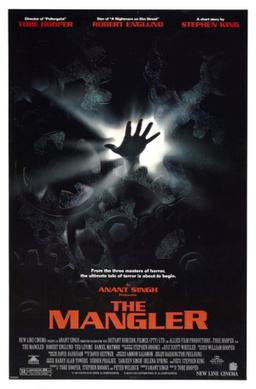
The Mangler (1995)


I wish I could say that we saved the best for last, but if you've read anything here you should know by now that Night Shift is guilty of inflicting the world with some of the worst Stephen King adaptations ever. The Mangler definitely scrapes the bottom, with some out-of-left-field humor being one of the movie's few saving graces. This review will be shorter than most, only because I watched this over a month ago and just couldn't work up the inspiration to give it a thorough recap.

Having watched this on the heels of reading Roadwork, I can only assume Stephen King had some unpleasant experiences with industrial laundry facilities. While in Roadwork, it was just an unpleasant place to work, in this story it is home to a terrifying machine that eats people when properly "woke". But this is no Exorcist knock-off, as John and his occult-knowledgeable brother-in-law discover the hard way; the machine works on antacids! I should say antacids and body-part and virgin sacrifices. Sure, why not.

Like many of the other adaptations from Night Shift, this movie also suffers from trying to pad a substance-lite story. The machine monster is stuffed full of CGI and the blood spray effect is in full use, making the movie's tone more violent and thrilling than the mysterious and lower-key one of the original story. Then again, if you have Tobe Hooper in the director's chair, you're probably expecting something a least a little bit gross.

Needless to say this movie bombed pretty hard and further diminished Tobe Hooper's already-sagging fortunes as a horror-movie icon. Speaking of horror-movie icons, Robert Englund gets top billing in this movie even though he isn't in it a whole lot, although I'll grudgingly admit his portrayal of a disgusting old disabled owner of the Laundry Shop of Horrors is pretty good.

Monday, May 14, 2018

Roadwork (1981)


This is our third trip to the Richard Bachman ouvere. If we learned anything from the past two visits, it is that Bachman is either really good or really bad. While I don't think that Roadwork quite plumbed the depths of writing that was Rage, this was definitely not The Long Walk. In fact, this book was so mediocre (as in not awful, not great) that it sort of killed that theory off altogether. So what makes a Bachman book different than your regular old Stephen King monograph? I think it's the lack of the supernatural element. That's not to say that nothing weird happens, but you won't meet anyone that can start fires with their minds, perform telekenesis, or communicate via telepathy. Well, what's the fun in that? When Bachman works, it means a dysfunctional world that could happen, but usually it ends up being thinly-plotted sketches that don't age well.

Roadwork is billed as "the novel of the first energy crisis" and is firmly set in 1973, eight years before the book's actual publication date. With Bachman, there is that chance that the manuscript may have been kicking around in a primitive form for years prior, making the novel's original intent to be timely. With gas lines, stagflation and other maladies of the 1970's, it seems like having both your workplace and your house tagged for demolition in the name of progress is the bitter cherry on top of an antifreeze sundae. While most of us would take the stoic's view and accept the buyouts and move on, our anti-hero Bart decides to wage a one man war against the inevitable. The 1970's were certainly not the dawn of the man versus machine scenario, but the 20th century in a nutshell reaffirmed the story that began in the previous century, that there are things too big for any one person to stop. Bart, however, decides to make a delusional wager that with enough firearms and bombs, one need not give in. His focus becomes so intense that he doesn't realize everything else in his life is destroyed in the process and the outcome of his self-defined final battle is no real surprise.

By the description of the plot alone, this does not guarantee a bad book. At times it even seemed like this book would break and mold and do something interesting, but all hopes for that turned out to be in vain. Roadwork is hampered by an unbelievable main character. I feel the intention was for us to identify with him, but instead he repels. Like the anti-hero of Rage, he is a jerk that appears to get pleasure from hurting others, physically and emotionally. He also strikes up the most bizarre relationship with a random hitchhiker and since she is female, of course they end up sleeping together for no plausible reason. All and all, this is a bleak story.

Finally, for the curious, there is no (nor was there ever) "Interstate 784". If we play along with the numbering system, if it did exist it would be a spur of Interstate 84, which is split into two parts, one that runs from Oregon to Utah, the other from Pennsylvania to Massachusetts. So the mostly-anonymous city this book takes place in would be somewhere between Scranton and Hartford, or (less likely) Portland and Salt Lake City. In fact, the descriptions of the city put it in the Midwest. The lesson here is don't read too much into this....or just about anything in this book.