Monday, July 24, 2017

The Stand (1978)


One daunting thing about this project is that Stephen King didn't mess around when it came to writing really thick novels almost right out the gates. Sure, Carrie was relatively thin (ranging from 200-350 pages depending on what edition you read), but 'Salem's Lot and The Shining cranked up the page count considerably. The Stand is the fourth novel he published under his own name, and would be the longest novel he wrote, even in it's "abridged" form, until the release of It in 1986, and still hold the #2 position (again, in abridged form) until Under the Dome in 2009. I'm actually looking forward to a shorter (albeit not short) novel when The Dead Zone shows up here later on.

The big question about The Stand is this: Is the original version too edited, or the uncut version too bloated? The jury is split nearly down the middle, but I sense some favoritism, probably induced by the author himself, toward the 1990 edition. In the interest of full disclosure, I have read the uncut version, but it was so long ago I had forgotten major plot points going into this one, so I don't feel I can confidently make comparisons. Bigger doesn't always mean better. Two of his most reviled books, The Tommyknockers (brought to you by booze and coke) and Dreamcatcher (by Oxycontin) are among the largest. However, the readers generally uphold The Stand in any version to be among the best of his books. As I detail below, I count myself among the fans, with really the only strike against the book in its original form being the over-edited feel.

Enough about page counts, let's talk about the book itself. I consider The Stand to be a double novel. You have your global epidemic story, a scientific apocalypse, in Book One, "Captain Trips", followed by a supernatural "classic" apocalypse" story in the other two books, "On the Border" and "The Stand". The first part was new territory in Stephen King's writing, much more science fiction than horror. The second part falls more in King's wheelhouse, focused more on action and suspense than the science. It isn't a hard break, as the second book straddles both parts. Therefore it would be hard to actually break the double novel into two discrete parts. Not that it is necessary to do so.

King did not invent the plague novel. There are more examples than I can think of from further back in history than I probably realize, but a few examples come to mind. Freshest in my mind is Earth Abides by George Stewart. Stewart, who wrote all kinds of books, took a hard scientific angle at how society would or could rebuild after a plague wipes out most of humanity. He spends a lot of time first describing the collapse of the old world, and then analyzing all of the challenges of rebuilding, right down to mundane stuff like education and agriculture. In other cases, like in Michael Crichton's The Andromeda Strain, readers are treated to a scientific explanation of a disaster that is warded off. Then you get crazy stuff like I Am Legend by Richard Matheson, where it is one "normal" man against a race of plague-altered mutants. King follows Stewart and Matheson in the "world failure" scenario. The government and its scientists are either idiots or monsters, not Crichton's heroes, and they are to blame for everything. Stewart doesn't bother to explain the real cause of his plague, and Matheson omits the birth and spread of his completely.

King and Stewart part ways in their approach in Book 2 of The Stand. Stewart obsesses deeply about how one rebuilds a society. While King also believes that people are more likely to pull together into large communities in the wake of disaster, he doesn't worry too much about the details. While certainly not advancing a Walking Dead-style Hobbesian anarchy, he is able to gloss over community building challenges in a way Stewart could not thanks to the character of Mother Abigail and her godly abilities to bring people together through dreams. When it comes down to the minutiae of running the Boulder Free Zone, nothing seems to be too difficult. Need a committee? Start a committee. Turn on the power, and eat from the largesse left behind. Only in the very last pages does King allude to future challenges, mainly in the form of undesirable leadership coming into power. Meanwhile, Stewart's protagonist (whose name escapes me, although I recall it was unusual) is wrestling with faltering education system and constant crop failure and other assorted agricultural issues.

Book 3 is what separates The Stand from its peers. I think it could even stand (no pun intended) on its own, but with 620 pages of buildup, the reader probably cares more about the characters than if they went in cold. First, it is our first real chance to see how the bad guys operate. The big surprise is that, in spite of Randall Flagg/The Walkin' Dude/The Dark Man/Actual Satan Himself driving their bus, most of the people there are not bad people. They just do the work they are assigned to do, like change lightbulbs and maintain military equipment for their defense. This opens the door to a host of theological questions a la King, as Flagg and his top men (Lloyd, Trash) are clearly evil or at least seriously deranged. If you distill the entire Las Vegas settlement to its basics, you soon realize that the community was destroying itself from within, even though a nuclear blast did most of the work, ultimately. Even though they were doing things that Boulder could only dream about, Las Vegas was morally empty, with no trust between the leaders and workers, or even between the leaders themselves.

As spectacular as the demise of Las Vegas is, the final hundred pages are really the heart of the drama. Glen, Larry, and Ralph go off to martyrdom (and no, I have no clue what the whole "hand of God" thing was), but what about Stu and Kojak? And even if they survive against all odds, what are they returning back to in Boulder? Even having read the book before, I was still riveted over how Stu pulls himself out of what should be a certain-death scenario and finding out if the ingenuity of Boulder is enough to protect a new generation from Captain Trips. At this point, Captain Trips is kind of a background nuisance, only coming out of hiding when a child with at least one non-immune parent is born. However, although he doesn't come right out and say it, it is clear one cannot simply "kill" Randall Flagg, not even with nukes, and he's out there somewhere. I guess I get to wait until the Dark Tower books to explore those avenues further.


Monday, July 3, 2017

In Progress: The Stand

Thanks to vacation and other fun things, The Stand, Stephen King's magnum opus, is coming up quicker than expected! If you were disappointed to not yet see an excoriation of Lawnmower Man or one of the other not-yet-seen movies from Night Shift, don't worry. I'll be watching and reviewing as I track them down. Admittedly I'm not putting much effort into this, but just think of future reviews as little surprises down the road.

June 4 (page 93): Even in its original shorter version, this book clocks in at over 800 pages, nearly double that of The Shining. Therefore, what would normally be considered good progress barely makes a dent here. The plague is getting started, but nothing serious outside of the army base where it burst out from. Especially impressive in this section are the character back stories, even the ones that are early Captain Trips fodder, and in particular the chapter sections describing the wild vectors the virus is taking through the country.

June 20 (page 260): I've been juggling some other books this month, so the updates aren't exactly copious. However, I finally reached the end of Book 1 ("Captain Trips") and figured it was time for some quick reflection. Stephen King has managed to kill off 99.4% of the world's population in the space of a short novel, inadvertently making the previous three books substantially less scary. So far the book has read more like a warped version of Earth Abides, but the Dark Man has appeared twice now and the dreams are beginning, which will sort out the survivors. The next book ("On the Border") will physically bring the groups together, something that has barely started at this point. The last sentence ominously portends the conflict ahead between Harold and Stu.

July 3 (page 428): Maybe my recall of the long version, which I read years ago, is not so great, but much of the focus has been on the "good guys" in Boulder. Randall Flagg has been pretty infrequent and Lloyd has been minimized. True, Trashy has gotten quite a bit of coverage, probably more than the rest of the baddies put together, which I don't really consider a good thing. Trash Man makes me feel dirty just reading about him. As I continue through Book 2 ("On the Border") it feels like King is wrapping up the scientific part of the book and getting a lot more theological and/or paranormal. While I don't prefer the supernatural, I understand it comes with the territory when reading Stephen King, and therefore the narrative is actually becoming more engaging. Yet, here we are halfway through the book, and no sign of confrontation yet. Harold's on the edge though. Just add Nadine and....kaboom. (I've also moved this post back to the top so it isn't buried by Graveyard Shift and Children of the Corn....you're welcome.)

July 9 (page 621): I've been picking up speed, and reached the end of Book 2 last night. For about the last 300 pages, the focus has stayed entirely in the Boulder Free Zone, but I sneaked a peak at the beginning of Book 3 ("The Stand"), and we're finally going to get a look at how the other half lives. While I still contend that King's theology is nothing special, it certainly is driving the second half of the book. Those we think of as marginalized in regular modern society have inherited the Earth, as represented by society in Boulder. Nobody was really powerful before the plague. Stu was just one of the guys, Fran was thinking about what to do with her life, and (looking to the other side), Trash and Lloyd were in and out of jail. Nick (deaf and mute) and Mother Abigail (108 years old) by their very conditions were not valued in the previous world. Only Larry, who had the dubious honor of performing the last hit (?) song of the old days, carries any modicum of fame with him, and he has been pretty good at denying that ever happened.

July 13 (page 747): This will probably be the last update and I'm now reaching the part where the pages fall out. Since all copies of this version are old and this is a mass-market paperback, even with heavy tape, the last few pages are literally falling out. Unless this version is drastically different, I continue to be surprised by how little I remember from my first reading of the novel. For such a giant book, the real confrontation doesn't even get underway until the last 100 pages. Also, where Book 2 was almost entirely about the Boulder Free Zone group, Book 3 hasn't even devoted one page to how things are going since Stu, Larry, Ralph, and Glen took off. Only Stephen King could write a book longer than all his other previous books combined (eh...maybe half anyway) and still have me feeling like he is rushing the narrative. No wonder he gave the world the unabridged edition 12 years later.

Tuesday, June 27, 2017

Movie: Graveyard Shift (1990)


While there are many interesting stories in Night Shift, "Graveyard Shift" wasn't really one of them. It was one of Stephen King's first stories to appear in a professional magazine. Though Cavalier wasn't exact renowned for its stories, you go where the work is, I suppose.

Translated verbatim, "Graveyard Shift" would make an (even more) terrible movie, so substantial changes needed to be made to create a convincing 90-minute movie. First off, the mill staff is entirely male, which could never work in a feature film that isn't about war, so female characters are inserted, and one of the existing characters, Wisconsky, is now female. Warwick, who wasn't exactly in the running for "world's best boss" in the story, is twisted up into a real monster with no regard for his employees (or OSHA for that matter), verbally and physically abusing them constantly through the movie. Hall is cast as an exceptionally good character, who in short order hooks up with Wisconsky. And there you have it: the hero, the villain, and the damsel in distress roles are all filled. Oh, and there is also an actual graveyard awkwardly stuffed into the narrative.

I will give very feeble credit to this movie on two counts: (1) it is one of the few to actually be filmed in the state of Maine, and (2) the sets were actually pretty well done. If their intention is to depict a cleanup operation of a hopelessly decrepit facility, they succeed admirably. However, if your factory is so far gone that you need to put a fire hose to the rodent problem, destroying your (probably worthless) assets in the process, you may want to consider fire instead and take the insurance money!

Much to my surprise (and horror), the movie actually made money. Somehow they managed to recoup the millions it cost to make the movie, and then some, opening the door to further cruddy adaptations of marginal Stephen King works. The director, Ralph Singleton, however, never directed another film after this, his directorial debut. Davd Andrews (Hall) has enjoyed a fairly robust career in television since this movie. Stephen Macht (Warwick), who has the most garbled Maine accent I've ever heard in my life, is also mostly in television (soaps and basic cable stuff), as well as some truly regrettable movies. Supposedly he was supposed to be Capt. Picard on Star Trek: The Next Generation, which obviously didn't happen.

On a side note, I ended up watching an edited version of this movie, complete with awkward commercial interruptions, on the Sundance channel. You may think that because the channel say "Sundance" it shows award-winning cutting-edge stuff without editing for time, content, or to fit your screen, but you'd be wrong. Apparently that all went away in 2007 and it is now on par with sister channels AMC and IFC, meaning the original series stuff is probably decent, but the movies they show are just a bunch of garbage filler. Lessons learned. I probably didn't miss a whole bunch here.

Tuesday, June 20, 2017

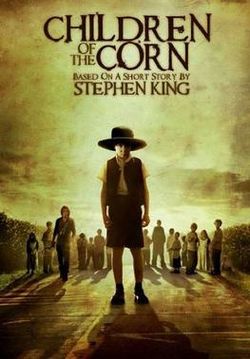
Movie: Children of the Corn (2009)


Let us take a moment to sort out the vast Corn franchise. The original short story appeared in Penthouse in 1977, to the delight of those select few who were reading for the stories. A year later it was anthologized into Night Shift. Seven years later it broke out on to the big screen, the first of many movies from Night Shift to receive the movie treatment. In the 1990's no less than five sequels were cranked out, all straight to video except for 1992's Children of the Corn II: The Final Sacrifice, which proved yet again a proud tradition of horror franchises that using the word "final" did not mean anything of the kind. Even bringing back Isaac (played by then 40-year-old John Franklin) couldn't reverse the sagging fortunes of the franchise and it seemed that 2001's Children of the Corn: Revelation (the seventh time around) marked the end of the road.

Enter SyFy, the network that proudly serves up big heaps of Sharknado movies every weekend, to bring Children of the Corn back to life in 2009 with a complete reboot. I'm not sure if this was the reboot America was crying out for, but it happened and I watched it.

The 2009 version is part of a larger trend in Stephen King movies to be more faithful to the source material. Especially in the case of short stories, where the sin of padding instead of cutting occurs, this would seem like a welcome development. Unfortunately, the result is a much more boring movie. If you loved the original short story, watching this will make you think you've already read the shooting script, as, for the most part, they play things very close to it. Vicky and Burt bicker, they get killed by the children, and the fateful decision to lower the death-ceremony age to 18 is played out.

On one hand this version is surprising in that it keeps the action in the mid-1970's, meaning the production team decided to keep everything relatively period-specific in terms of fashions and cars and so forth. They could have copped out and just made it present day. On the other hand, they are so obsessed at driving that point home that they added a bunch of padding about Burt struggling with his tour of duty in Vietnam that gradually overwhelms the entire narrative. They also make an executive decision to make Vicky African-American, casting Kandyse McClure in the role. Faithful readers of this blog may remember her as black Sue Snell in the 2002 Carrie, while everyone else knows her as Dee from the re-imagined Battlestar Galactica. She never really bothered me in those shows, but here she is generally obnoxious, more so than Vicky was in the story, plus throughout she is wearing a yellow dress the size of a large cocktail napkin. Not exactly the gear you want to sport to battle the Old Testament kids.

A big change in this version is that the kids are much younger. While the 1984 movie, for example, cast a 25 year old man as 13 year old Isaac, this one goes the other direction, casting a nine year old that bore a strange resemblance to Joe, the little kid from Modern Family. Even if  you can get around the fact they probably cast him too young, it gets pretty clear the actor was being forced to utter a bunch of Old Testament prophecy that made no sense to him.

Finally the producers decided it was necessary to show how the children of the corn made...uh...more children of the corn. I guess I could have filled in those blanks on my own, but apparently the creepy death ritual performed on the 19 year olds doesn't shock (or titillate?) modern audiences. I guess the 1980's were a more innocent time after all.

Wednesday, May 24, 2017

Movie: Children of the Corn (1984)


Although the page-to-screen time was a little lengthy, the Children of the Corn movie franchise is now up to nine, with a tenth on the way! Needless to say, I'm going to limit myself to two, this one and the 2009 TV remake (which I am already aware is awful), otherwise I may be stuck here for a good long while.

Like a lot of the Night Shift screen adaptations, it was hard to see how one would stretch Children of the Corn into a 90-plus minute feature film. Like observed with Maximum Overdrive and anticipated with all the rest, extra padding of the story plot was needed. Whereas the story drops a bickering couple into a mystery, the movie portrays a mostly-loving couple (though Peter Horton stops things short of wedding bells) entering a situation we the viewers already know is going to be dangerous thanks to the helpful flashback tacked on to the beginning. While the flashback is certainly educational, it sucks the Twilight Zone feel out and replaces it with stock "don't go in there!" horror tropes.

Also in the padding department is the development of the child characters. In the book, they are mostly just a bunch of Old Testament names and all corrupted. In the movie, Malachi is propped up as the diabolical one, Isaac as the clear leader (yet flawed and overthrown), and the brother and sister Job and Sarah, who are salvageable and are, in fact, rescued by the heroic couple (and in all fairness Linda Hamilton was about to become Sarah Connor, so it only makes sense they will save the day). This is quite a turn from the story, where the couple is flat out killed in the cornfield.

Finally, maybe because there was special-effects money to burn, the movie posits that there is some creature along the lines of the Tremors monster that is making all the kids do these things. Again, this serves to make the mysterious scary and sets a different tone from the story. Obviously what seemed like a nuclear detonation in the cornfield didn't stop this creature permanently, otherwise we wouldn't have the five direct-to-video sequels. Or maybe some other shenanigans take place later on. This all goes past my concern, though.

As I mentioned, there was a little more lag in page-to-screen between the appearance of the short story in Night Shift and the release of the movie. The first three novels all received adaptations four years or earlier from their book date of release. Children of the Corn was the first of numerous movies spawned from Night Shift, but took over six years to make it (add another year if calculating from the story's first appearance in Penthouse). After this, however, it would be a torrent of mediocre to outright-awful movies being barfed out almost annually.

Here's a weird factoid to leave you with. John Franklin, who played 12 year old Isaac, was 25 years old when the movie was released. I guess this makes him the white Emmanuel Lewis, but it should also give great hope to aspiring actors who look very young for their age!

Sunday, May 14, 2017

Movie: Maximum Overdrive (1986)


My theory that the worst movies are the most frequently shown on television was absolutely crushed, when, of the entire smorgasbord of Night Shift adaptations, only Maximum Overdrive was readily available. In the interest of full disclosure, I've seen parts of this movie, as it seems to always be on one premium channel or another, but I've never actually intentionally sat down to watch it from start to finish. There is such a high amount amount of unnecessary profanity I can only imagine how this would have played on network television, especially the cursing ATM and marquee at the beginning.

According to the library listings at stephenking.com, Maximum Overdrive was the twelfth Stephen King movie to be made (unless you don't count Creepshow, and then it's number 11). This means, by 1986, the "Stephen King Movie" genre had really started to settle in, which isn't necessarily a good thing if you're holding out for Oscar nominees. Just to be extra special, Maximum Overdrive is directed by Stephen King himself, right at the height of his coked-out phase. The result is nothing short of craptacular.

It's hard to know where to even begin with a critique of this movie. It was only the second movie (following the still-warm Children of the Corn) to be based entirely on one short story. Therein lies part of the problem. Whereas a novel-based movie must slash, a short story-based movie has to pad. The source material, "Trucks" really doesn't offer enough to go feature-length, although I contend it would have fit nicely into a Twilight Zone episode (maybe one of the one-hour versions). So, in comes the padding. Extra characters abound, and, of course, an explanation about what is causing the machines to go haywire. Apparently a comet's tail can cause many (but not all) machines to malfunction. Trucks are the most impacted, becoming almost sentient, while smaller appliances just misbehave. And electricity isn't a requirement, as sprinklers also malfunction. Don't worry about regular cars, though. They are unaffected, although one can't rule out a freak car window rolling up unexpectedly and trapping your hand (complete with massive diamond ring), causing you to despair and die.

I digress, but clearly there are some inconsistencies here. From reading some secondary material, I suppose the intention of the film was to be "good-bad" so that people would appreciate that it is actually a clever movie that makes fun of other scary movies. Unfortunately, though the thick lens of cocaine, it came out more "bad-bad" - ridiculous is some ways, and just boring in others. Perhaps the whole "standoff at a truck stop in North Carolina that just happens to sit on a huge cache of weapons" plot line didn't work for me. The cast in general hovered somewhere between dislikable and forgettable, and lead man Emilio Estevez didn't have a lot to say, even it was because he spoke to trucks. Pat Hingle, who we met in the Shining remake, is here as a gun crazy, fast-drawling chauvinist station manager, who makes firing rocket launchers look surprisingly easy, almost like he modified a toy to shoot actual missiles. One fringe benefit of bad movies like this one is catching an actor or two before they were really famous. In this case, look sharp for Marla Maples (playing "Woman #2") and Giancarlo "Gus Fring" Esposito as an ill-fated video game enthusiast. Do they make the movie worth watching, though? No. Maybe better to watch a Breaking Bad marathon. At least Esposito has some lines in that!

To be clear, this was a bona fide bomb. I have gained some understanding that a lot of Stephen King material from the mid and late 1980's, both page and screen-based, are not particularly top notch, and probably reflected the bad place King was in mentally and physically. It should be acknowledged however, that these works can also be comfort food of a sort, if it reaches one in the right state of mind at the right time. Therefore, I wouldn't necessarily say this is a movie that never should have been made, but there is a time and a place for these things, and I just wasn't there in either sense. Perhaps it will be (or was) different for you.

Tuesday, May 9, 2017

Night Shift (1978)


For this post, which will probably be shorter than the ones on his first three novels, I'll be discussing more "big picture" concepts about the collection rather than delving into individual story details. More by accident than design, that kind of thing can be found in the previous post.

Believe it or not, one part of this project I was looking forward to was tackling the volumes of collected short stories by Stephen King. Some have, for better or worse, become part of the pop culture fabric of the last half century. However, as was evident with Night Shift, that wasn't a fully-formed development. All great writers take time to find their voice, and King is no exception (and we can argue elsewhere about the "great" label!).

If I had approached this in the strictest chronological order possible, about half of these stories would have kicked off the project, beginning with "Strawberry Spring" from 1968. I think some of the later collections might have thrown in some early stories as well, but my mind isn't there yet. To make matters even more confusing, the publication data provided in the back of the book masks a couple of the stories, "Strawberry Spring" and "Night Surf", which were originally published in Ubris, a student literary magazine, but are given the later dates (1975 and 1974 respectively) of their publication in Cavalier, presumably in slightly reworked form.

The stories are laid out in publication order, but not strictly so. Given that 'Salem's Lot was still pretty fresh in 1978, the temptation to kick things off with a "previously unpublished" story related to that universe was probably overwhelming. Most of the stories published prior to the publication of Carrie fall in the first half of the book and exhibit the developing author. From "Sometimes They Come Back" onward, the stories are those of an author with one well-known novel on the market and in general are more solidly written. The last few stories are either originals, or published outside the men's magazine market, showing King's growing appeal on the mass market.

King was a pretty regular contributor to Cavalier, and just over half of the stories in this book appeared in their pages. Two were published in Penthouse and one in Gallery, which means those few people that read these magazines for the stories were richly rewarded, or at least provided a more believable cover story for what that pile of magazines was doing under their bed. Writing forty years in the future, it seems pretty crazy that he would publish in men's magazines best known for their photos, but it really shines a light on the author King was perceived to be in the 1970's. This is very pre-Green Mile and still a couple years in front of the time in which anyone would suspect a director like Stanley Kubrick would take an interest in adapting one of his novels. You go where the money is, I suppose!

As I've alluded to, Night Shift would provide the fodder for no less than ten movies, six to the big screen and four TV adaptations, and this does not take into account the gazillion sequels and remakes of said movies. Short stories are more tempting to adapt, I think, because you don't need to cut out stuff to make it fit into a feature length running time. However, sometimes you need to pad, and that's where the problems begin. I'll gradually explore some, if not all of these, as I can find them, and appropriately bemoan all their faults. Stay tuned for the most prevalent and ghastly of the bunch...Maximum Overdrive.