Thursday, June 28, 2018

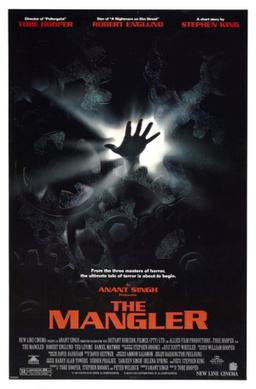
The Mangler (1995)


I wish I could say that we saved the best for last, but if you've read anything here you should know by now that Night Shift is guilty of inflicting the world with some of the worst Stephen King adaptations ever. The Mangler definitely scrapes the bottom, with some out-of-left-field humor being one of the movie's few saving graces. This review will be shorter than most, only because I watched this over a month ago and just couldn't work up the inspiration to give it a thorough recap.

Having watched this on the heels of reading Roadwork, I can only assume Stephen King had some unpleasant experiences with industrial laundry facilities. While in Roadwork, it was just an unpleasant place to work, in this story it is home to a terrifying machine that eats people when properly "woke". But this is no Exorcist knock-off, as John and his occult-knowledgeable brother-in-law discover the hard way; the machine works on antacids! I should say antacids and body-part and virgin sacrifices. Sure, why not.

Like many of the other adaptations from Night Shift, this movie also suffers from trying to pad a substance-lite story. The machine monster is stuffed full of CGI and the blood spray effect is in full use, making the movie's tone more violent and thrilling than the mysterious and lower-key one of the original story. Then again, if you have Tobe Hooper in the director's chair, you're probably expecting something a least a little bit gross.

Needless to say this movie bombed pretty hard and further diminished Tobe Hooper's already-sagging fortunes as a horror-movie icon. Speaking of horror-movie icons, Robert Englund gets top billing in this movie even though he isn't in it a whole lot, although I'll grudgingly admit his portrayal of a disgusting old disabled owner of the Laundry Shop of Horrors is pretty good.

Monday, May 14, 2018

Roadwork (1981)


This is our third trip to the Richard Bachman ouvere. If we learned anything from the past two visits, it is that Bachman is either really good or really bad. While I don't think that Roadwork quite plumbed the depths of writing that was Rage, this was definitely not The Long Walk. In fact, this book was so mediocre (as in not awful, not great) that it sort of killed that theory off altogether. So what makes a Bachman book different than your regular old Stephen King monograph? I think it's the lack of the supernatural element. That's not to say that nothing weird happens, but you won't meet anyone that can start fires with their minds, perform telekenesis, or communicate via telepathy. Well, what's the fun in that? When Bachman works, it means a dysfunctional world that could happen, but usually it ends up being thinly-plotted sketches that don't age well.

Roadwork is billed as "the novel of the first energy crisis" and is firmly set in 1973, eight years before the book's actual publication date. With Bachman, there is that chance that the manuscript may have been kicking around in a primitive form for years prior, making the novel's original intent to be timely. With gas lines, stagflation and other maladies of the 1970's, it seems like having both your workplace and your house tagged for demolition in the name of progress is the bitter cherry on top of an antifreeze sundae. While most of us would take the stoic's view and accept the buyouts and move on, our anti-hero Bart decides to wage a one man war against the inevitable. The 1970's were certainly not the dawn of the man versus machine scenario, but the 20th century in a nutshell reaffirmed the story that began in the previous century, that there are things too big for any one person to stop. Bart, however, decides to make a delusional wager that with enough firearms and bombs, one need not give in. His focus becomes so intense that he doesn't realize everything else in his life is destroyed in the process and the outcome of his self-defined final battle is no real surprise.

By the description of the plot alone, this does not guarantee a bad book. At times it even seemed like this book would break and mold and do something interesting, but all hopes for that turned out to be in vain. Roadwork is hampered by an unbelievable main character. I feel the intention was for us to identify with him, but instead he repels. Like the anti-hero of Rage, he is a jerk that appears to get pleasure from hurting others, physically and emotionally. He also strikes up the most bizarre relationship with a random hitchhiker and since she is female, of course they end up sleeping together for no plausible reason. All and all, this is a bleak story.

Finally, for the curious, there is no (nor was there ever) "Interstate 784". If we play along with the numbering system, if it did exist it would be a spur of Interstate 84, which is split into two parts, one that runs from Oregon to Utah, the other from Pennsylvania to Massachusetts. So the mostly-anonymous city this book takes place in would be somewhere between Scranton and Hartford, or (less likely) Portland and Salt Lake City. In fact, the descriptions of the city put it in the Midwest. The lesson here is don't read too much into this....or just about anything in this book.


Tuesday, April 3, 2018

Battleground (2006)


One of the quirkier adaptations, as well as one of the last original adaptations from Night Shift, "Battleground" is not a movie, but the pilot episode of the short-lived limited basic cable series Nightmares and Dreamscapes: From the Stories of Stephen King. Anyway, this should not be confused with the story collection of the same name that King published in 1993, even though most of the episodes actually do come from that book.

In both story and movie, "Battleground" is largely a single human character, played here by William Hurt, interacting with no-longer-inanimate objects. While there is some room for dialogue, particularly at the beginning when he carries out his hit on the toy-maker, the entire episode is dialogue-free. This works pretty well for the main section of man-versus-toy soldiers (even though I'd be hollering holy hell at those little green men), but elsewhere it is a little forced.

At times the action seemed a little silly. For example, nobody in his luxury apartment building seemed bothered by the fact he was shooting up his furniture with an assault rifle or wrecking their elevator. However the well-done special effects (under supervision of director Brian Henson....yes of that Henson family) helped to smooth out the instances of the incredulous. Of course, the fun of the story is not knowing what bonus surprises are hiding in the toy solider box. So it is possible that those who never read the original story would be more floored by the outcome than those who are waiting to see what a miniature hydrogen bomb will look like on screen.

Given the mediocre nature of some of the other adaptations from Night Shift, especially the later ones, this was a little breath of fresh air. It is certainly something to look forward to when this project advances thirteen years further in Stephen King's publishing history.

Tuesday, March 13, 2018

Trucks (1997)


Trucks is one of the stragglers in the ten adaptations that come from the Night Shift stories. For reasons that should become abundantly clear as this blog post unfolds, it isn't one that gets shown on TV much anymore. It also is another victim of the "let's try it again" phenomenon of the 1990's and beyond that needlessly dulled movies in the interest of attempting to stay faithful to the original written story (e.g. The Shining, Carrie).

Now I can understand the motivation to update some of the oldest Stephen King movies, be it to modernize them or fix the perceived flaws of the original. However, I'm scratching my head a little over the decision to re-do Maximum Overdrive. It seems like perhaps they wanted to "get back" to the original concept, seeing that they even returned the name of the original short story. Surprise, surprise, though, this version defied the trends of the day and actually wandered further away from the original. In fact, I dare say this was a remake of Maximum Overdrive that gave no consideration to the original story, like they hadn't even read it.

The short story "Trucks" never revealed exactly where the truck stop was situated, while Maximum Overdrive put it in North Carolina (home of most of the Dino-era movies), and this one moved the action out west into some kind of Roswell/Area 51 hybrid area. Conveniently, this accommodates the natural beauty of the Canadian prairie where the movie was shot.

The agony or beauty (you choose) of "Trucks" was that you never know how or why the trucks became sentient and the readers are left with the bleak feeling of a world where humans must now serve their new truck overlords. This would understandably make a terrible movie (or an Oscar winner, depending on the director), so Maximum Overdrive went through the trouble of explaining how the whole situation arose. Since it was a (spoiler alert!) comet, the intrepid band of humans pretty much just had to wait it out and things got back to normal, a fact relegated to a paragraph stapled on to the end of the movie. Clearly, Chris Thomson, director of Trucks and other mid-grade TV projects, felt this was half-measure and laid out possible causes like military projects gone wild and toxic spills, which the humans could fight against and fix.

An interesting difference in Trucks is what is affected by the "sentient truck" bug. Maximum Overdrive used an expansive approach that impacted all kinds of equipment, like electric knives and ATM's, and even sprinklers that have no motor I've ever seen, while regular cars were surprisingly immune. Trucks sticks pretty much to just actual trucks, but doesn't bother to distinguish among trucks. This scene, for which I cannot improve with commentary, says it all:


Other than being kind of boring, the main problem with Trucks, and with most pre-2000 television movies, is the obvious cut corners. Leading man Timothy Busfield probably didn't wreck the budget. But most telling is that a situation where a group of humans are trapped by trucks at a truck stop requires more than three trucks. I never got the feeling they were really trapped. Instead it just felt like the whole crew suffered from bad timing, always venturing out of safety right when a truck happened to be cruising by. Ultimately it is stuff like this that made Trucks not so much a blown opportunity as an unnecessary production. Why mess with "perfection"? 

Thursday, March 8, 2018

Firestarter (1984)


The Dino Di Laurentiis film festival continues here on Under the Tome. Admittedly he wasn't directly involved as a producer in this one (unlike The Dead Zone, Cat's Eye, and Maximum Overdrive, our previous feature presentations), electing to delegate to Frank Capra.....Jr. However, Firestarter fits very nicely into the sequence of these movies, which I think are best described as mediocre films with underachieving casts. It is pretty impressive that they managed to squander the talents of Drew Barrymore (fresh off E.T.!), Martin Sheen, and George C. Scott, and even more impressive that they attracted these actors in the first place. I suppose they were doing two-film deals with Martin Sheen, who is following up his turn in The Dead Zone, while Drew Barrymore returns in Cat's Eye. If those movies were really good, I suppose we could chalk this one up to contractual obligations. As for George C. Scott playing "evil Indian" John Rainbird, I've got nothing (actually, keep reading). This is also where the director chair falls into no-name territory in Dino's world. Mark Lester would go on to direct Commando the following year, but really didn't have much of a C.V. coming into this movie. Future directors Lewis Teague and Stephen King himself didn't do anything to reverse this trend, making it all the stranger that a director like David Cronenberg was ever involved in these projects.

In relation to everything I've watched so far for this project (Dino or no Dino), this one is actually mostly faithful to its novel. However this is not a ten-hour movie, so some things had to be cut, and that's where I think the movie hurt itself. Obviously the back story had to be boiled off, and that decision was fine, but it seemed like the dark humor of the novel was also left on the cutting room floor. For example, Andy doesn't get to use his powers of suggestion to make people ignore a screaming blind government agent, make a scientist stick his arm in a garbage disposal while wearing women's clothes, or make Captain Hollister become completely OCD about golf and snakes. Losing these elements made the movie much drearier than it could have been. Finally, probably also in the interest of staying compatible with the under-two-hour running time, the movie dumps the book's drawn out pacing. For example, instead of Charlie and Andy hanging out at the cabin all winter long, they get sussed out almost immediately. If any time passed at the Shop they made no effort to indicate it, as David Keith didn't need to wear a fat suit to satisfy the book's way of indicating a passage of time.

Racial stuff aside, I have to credit George C. Scott for doing the best he could with this material. When John Rainbird fakes being nice, he really does a convincing job that he is this sensitive janitorial type that Charlie cannot resist. It's just too bad that he gets tripped up by curious production decisions, forcing him to be scared of the dark, but the place is completely lit up as if they put a night-vision goggle rig in front of the camera when filming. I mean, the point of the blackout is for everything to be completely dark to the point of not being able to see your hand in front of your face, right? I get the whole "conveniently located outdoor lights", "bright moonlight", or good old-fashioned "day for night" strategies when filming night scenes, but it is really hard to feel bad about somebody who is afraid of the dark with so much light on the set. Maybe Drew Barrymore could have lit a fire?

Thursday, March 1, 2018

Firestarter (1980)


With the publication of Firestarter, it was probably getting hard to ignore that Stephen King was settling in to a pattern, writing about special people, often of a youthful age, that are not understood by the population around them. In fact, especially in the case of the younger ones, these special people do not fully understand themselves. Quickly reviewing his first six books (Carrie, 'Salem's Lot, The Shining, The Stand, The Dead Zone, and the featured book of this post), this applies to all of the books except 'Salem's Lot. Additionally this gives some more justification to "the importance of being Bachman", as those books don't follow this pattern, giving King a chance to flex a different literary voice. Also, I'm leaving out Night Shift because it's not a novel and covers a wide spread of King's early literary career.

Now writing about the same subject repeatedly isn't a bad thing, keeping in mind auteur theory and all that, but in the case of Firestarter there wasn't quite the thrill that King delivered with his earlier novels. The idea of a shadowy government outfit trying to reverse engineer and exploit supernatural powers seemed a little to much like the plot of an X-Men movie. The government as the antagonist is no new thing for Stephen King (The Stand, The Dead Zone) but never so directly cast in the role as they are here. Also, another annoying crutch reappears here in the form of young children speaking with adult voices under the pretense that they are exceptionally smart. I'm deliberately trying to stay away from talking movies, but it forces adaptations to either use much older actors (see 'Salem's Lot), or, as the movie version of this book did, make the original dialogue more "child-like". One thing new to a Stephen King novel, but a bit of an obnoxious trope in other works of fiction is the "evil Indian", a Native American character who has decided to use his special native powers to manipulate and kill in ways the white man would never understand. While this is disappointing, let's just say I had never imagined George C. Scott in the role of John Rainbird. (We'll save this for the next post.)

If one thinks too hard about the plot here, this is probably one of King's most preposterous novels. In the case of the aforementioned X-Men, the insurmountable problem is that they were born that way. While Charlie was born into her frightening power of pyrokenesis, Andy and Vicky were just normal people who, thanks to one drug test gone wild, not only acquired (or became able to express) special powers, but also could genetically pass along their new skills! Then again, perhaps that's the fun of it. I found this to be one of his funniest books. Seriously? No, bear with me here. First off, the Shop is run by a bunch of morons. They played up the evil role to nearly hyperbolic proportions, which played right into Andy's power of suggestion, bringing out darkly hilarious skeletons from closets involving intersections of women's clothes with garbage disposals and golf with snakes. Even earlier in the book, Andy's suggestive powers caused people to calmly converse while standing right next to a Shop agent screaming that he was blind.

I will say one great thing about the book is the pacing. For most of the second half of the book I thought it was going to be any minute that Charlie blew the Shop to fiery bits and the anticipation of the moment kept me turning the pages. Darn you, Stephen King, I had to get past page 500 before the fireworks started! But the unraveling of the Shop was handled very well. By the time things started exploded, the whole operation was pretty much on its last legs and probably wouldn't have survived even if Charlie left the place standing. It's important to remember this isn't a mystery novel, so the possibility of the Shop actually succeeding at anything never got on my radar, and it was really more the act of witnessing their undoing that made reading this book enjoyable.

Tuesday, February 6, 2018

In Progress: Firestarter

29430667
With Firestarter we continue (and probably end) a trend of knowing less and less about a particular book going into it. Unlike The Dead Zone, this book is far less likely to be a response to "name one Stephen King book". In a recent ranking of every Stephen King novel this one comes in at #12, lacking the hallowed status of The Shining (#1), but also the notoriety of, say, Cujo (#39). Perhaps it the bias of the list author, but the earlier novels completely dominate the top ten, so it may be a wild ride ahead for his project.

February 6 (Page 87): So far so good, but it feels like King took a step back for this one in terms of plot. Since Carrie he's been rolling out increasingly complex works and here we have something that reads closer to Carrie than any of the previous books: a child with powers she cannot control and doesn't fully understand. At least it seems like her parents are a bit better adjusted than poor Carrie's, but come to think of it, outside of the flashbacks to 1969 we don't know where Mom is. (The book nominally takes place in 1981, but the Padres didn't make the World Series until 1984. Bah, nobody's perfect.)

February 9 (Page 198): If you needed some kind of demonstration of just how bad Charlie's pyrokenesis can be, you get it here in the "Incident at the Manders Farm" chapter. One sinister character (Al Steinowitz) turned out to be a paper tiger, and an inflammable one at that, while a new psychopath (John Rainbird) is getting ready to start his vision quest. Rainbird reminds me of the psycho Native American from the second season of the TV show Fargo, so I guess it's a trope now to have these guys that are extra dangerous because they can use their special Native American skills in the most horrific ways possible. All the while, am I the only one who find it strange that two normal people take a trial drug that not only give them psychic powers, but all can then pass it off exponentially to their offspring?

February 11 (Page 289): This must be one of those books with a definite mid-point, or at least an act came to a close. From the bad guy perspective, it looks like Rainbird made a power play on Cap, and managed to become even more creepy in the process. From the point of view of our heroes, I guess all good things must come to an end. It turns out the shelter in Vermont was all an illusion pretty much from the moment Andy and Charlie arrived. I've already sneaked a peak at the start of the next chapter and it looks like the chronology advances further. Add to this the lengthy flashback to what started the whole chase, plus the season spent at the cabin, and it shows a broader perspective than a Carrie-type novel would have. So although I still contend this is a step back for Stephen King, it isn't all the way back to basics.

February 15 (Page 431): Any time you encounter a chapter called "Endgame" you know things are about to get real. Taking a really long term perspective, even not having finished the book yet, these government dweebs never had a chance against fully-aware Andy and Charlie. Even Cap seemed to indicate that the Shop had more than a little Keystone Kops flavor to it when he was pushed/hypnotized by Andy. The only thing keeping things from being a blowout already is that these special powers don't come for free. More on this for the main post coming soon.